

Holographic technology can fully record and reproduce the wavefront information of the light field, playing a crucial role in fields such as 3D display, data storage, and optical encryption. For instance, holographic 3D display technology does not require wearing devices and is less likely to cause visual fatigue, and is regarded as the ultimate solution for applications such as near-eye display in virtual reality (VR)/augmented reality (AR) and smart vehicle head-up displays (HUD). However, traditional holograms can only record a single image and are difficult to achieve dynamic stereoscopic display.
In contrast, the emerging orbital angular momentum (OAM) holographic technology utilizes the OAM degree of freedom to create a vast storage space for information. Similar to film in movies, hundreds of images can be recorded in the same OAM multiplexed hologram. Each frame of the image corresponds to a specific OAM order, which is equivalent to being assigned an exclusive code. By successively irradiating different orders of OAM beams onto the hologram, dynamic refreshment of three-dimensional images can be achieved, theoretically significantly enhancing the information capacity and security of holographic technology.
However, the large capacity and high resolution of the OAM hologram are in contradiction. Due to the strong crosstalk between the various OAM channels of the hologram, in order to ensure that the OAM properties at each pixel position are not disrupted, the original image must undergo sparse sampling (Figure 1a) – strictly requiring that the sampling interval (L) is not less than the diameter (dmax) of the highest-order OAM mode, that is, γ = dmax/L ≤ 1. When γ = 1, it corresponds to the resolution limit of the current OAM holographic technology, as shown by the blue curve in Figure 1b. As the number of multiplexed channels increases (dmax increases), the image resolution suffers a significant loss (L increases proportionally). This bottleneck problem greatly limits the capacity and resolution improvement space of the OAM holographic technology.
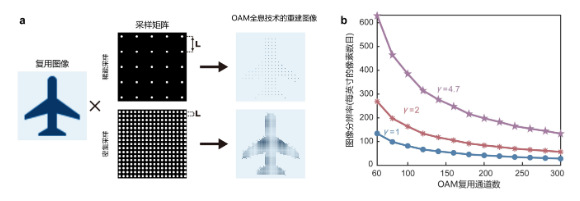
Figure 1. The contradiction between resolution and the number of multiplexed channels in OAM holographic technology
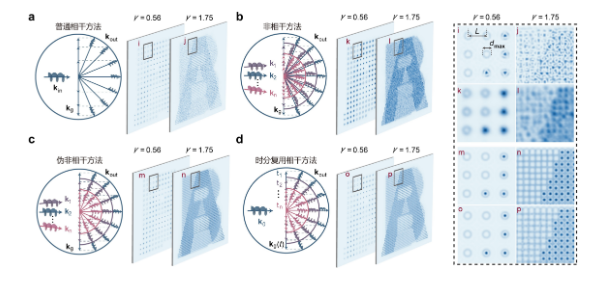
Figure 2. Schematic diagram of the sources and suppression methods of multiplexing crosstalk in OAM holographic technology
To address these challenges, the Advanced Laser Technology Team of the School of Precision Instrumentation at Tsinghua University established a comprehensive analysis model for OAM holographic multiplexing crosstalk, proposed a nearly crosstalk-free pseudo-incoherent method, and achieved an approximate coherent method through time-division multiplexing technology. The new technology relaxed the restrictions on the OAM holographic sampling conditions (γ can be increased by several times, as shown by the red and purple curves in Figure 1b), broke through the resolution limit of the existing OAM holographic technology, and significantly improved the resolution of the reconstructed image (under the same multiplexing channel quantity) and the multiplexing capacity (under the same resolution). The working principle is illustrated in Figure 2: The existing OAM holographic technology corresponds to the ordinary coherent method in Figure 2a. When γ > 1, the OAM characteristics in the reconstructed image are completely destroyed, causing strong multiplexing crosstalk; the non-coherent method in Figure 2b can suppress multiplexing crosstalk, but due to temporal/spatial dispersion, the reconstructed image becomes blurry; Figures 2c and 2d respectively represent the pseudo-incoherent method proposed in this work and the time-division multiplexing coherent method, which keep the OAM characteristics of the reconstructed image intact, even in super-resolution scenarios, and still achieve high-quality reconstruction.
Based on time-division multiplexing of 50 binary OAM holograms, this work demonstrates OAM multiplexing of 5 grayscale images under a 2-fold super-resolution condition (γ=2) (Figure 3), OAM multiplexing of 201 frames of video under a 4.7-fold super-resolution condition (γ=4.7) (Figure 4), and OAM multiplexing of 81 binary images under a 9.2-fold super-resolution condition (γ=9.2) (Figure 5), all of which exhibit superior reconstruction quality compared to the reconstructed amplitude OAM holography and phase-type OAM holography methods.
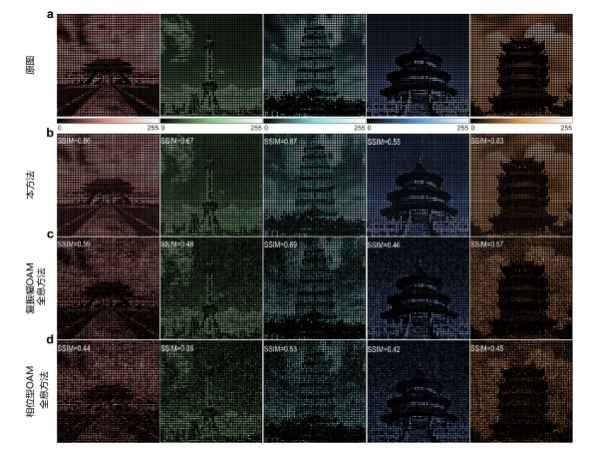
Figure 3. OAM multiplexing (2x super-resolution) of 256 grayscale images of five Chinese landmark buildings, where SSIM represents the structural similarity coefficient
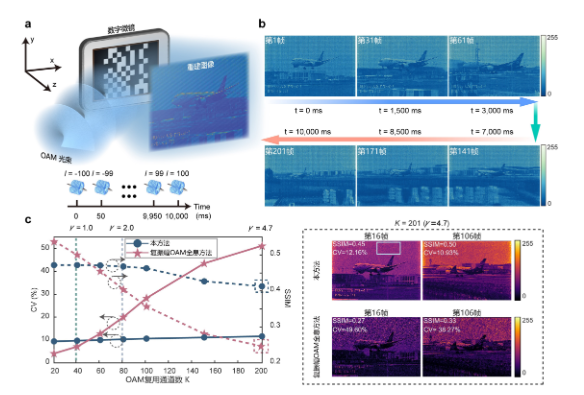
Figure 4. 256-order grayscale image holographic video with OAM multiplexing (4.7 times super-resolution): (a, b) 201 different OAM beams were successively irradiated onto the hologram to obtain 201 frames of high-quality holographic video; (c) Evaluation factors such as intensity fluctuation coefficient (CV) and structural similarity coefficient (SSIM) changed with the number of OAM multiplexing channels.
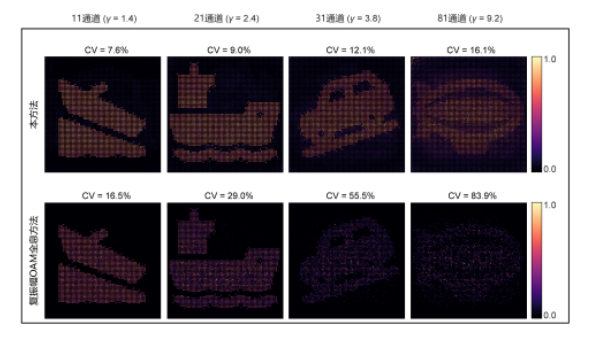
Figure 5. OAM multiplexing of binary images (up to 9.2 times super-resolution, 81 channels)
This technology is demonstrated using a digital micromirror array (DMD), but it is also applicable to various reconfigurable platforms such as programmable ultra-surfaces, ferroelectric liquid crystal spatial light modulators, and digital light processing projectors. This work provides a practical solution for realizing a holographic system with both high resolution and large capacity, and is of great significance for improving the performance of applications such as intelligent display, holographic encryption, and holographic storage. By further combining the iterative method of the hardware-in-the-loop, and correcting the image quality degradation caused by uneven illumination, optical system aberrations, and modulation device errors in the experiment, it is expected to achieve higher resolution and larger capacity OAM holographic multiplexing.
The research results were recently published in the journal “Nature Communications” under the title “Super-resolution orbital angular momentum holography”.
The completion unit of this research project is the Department of Precision Instrumentation at Tsinghua University, the National Key Laboratory of Precise Perception Technology for Spatiotemporal Information, and the Ministry of Education Key Laboratory of Photon Measurement and Control Technology. The first author of the paper is Shi Zijian, a 2019 doctoral student in the Department of Precision Instrumentation. The corresponding author is Professor Liu Qiang and Associate Professor Fu Xing from the same department. Other authors include doctoral students Wan Zhensong, Zhan Ziyu, and Liu Kaige from the same department. This research was funded by the National Natural Science Foundation of China.
Paper link: